When I was 20, I worked in Australia for 9 months on an agricultural exchange. I was placed on a mixed farm but was often loaned out to the neighbour’s or relative’s farms when they were involved in a big project or needed an extra hand. The brother-in-law of the family I was placed with had a very large sheep station, and I was tasked with helping them shear and dip their sheep one day. Growing up on a cattle ranch I had zero experience with sheep and had no idea what to expect. They had professional shearers, so I wasn’t given that job, and to gather, clean and grade wool was a learned skill I wasn’t qualified for at that point (though I learned later). So, my job was to herd the sheep into the sheep dip. It consisted of pushing the sheep toward a slide, which the sheep would ride down and get dunked into a swimming pool like vat of insecticide to protect the sheep from flies, ticks and lice. They went down the slide so they had enough speed that by the time they hit the bottom they would be completely submerged ensuring a complete covering of the insecticide. A man stood at the bottom to dunk them if for some reason they were able to avoid complete submersion.
The first draught of sheep went fairly well. We basically stood behind them and gave little encouraging yips and they would jump on the slide and away they went. It seemed like I was in for an easy day, unlike like everyone else whose jobs required a lot of bending and physicality, and by 9 o’clock were sweating profusely. Unfortunately, the first draught of sheep were yearlings, who had never experienced the dipping vat before. Once we got into the two-year olds the fun really began. For as stupid as sheep seem to be to me, they have excellent memories when it came to the dipping vat. We had to basically carry each sheep to the top of the slide and give them a push to get them to go. I suddenly realized why this job was given to the new guy. Even the working dogs they were using were too smart to get involved in this project. It was terribly hot, and after about thirty minutes it looked like I had been dipped!! All day long I cursed the man who invented the first effective sheep dip. All day long I cursed William Cooper.
I guess I also should have cursed George Wilson, the man who invented the first sheep dip in 1830 in Coldstream Scotland, however, his arsenic based dip wasn’t very effective, and given enough time, once the true dangers of arsenic poisoning were discovered, dipping sheep may well have been a thing of the past. But William Cooper reinvented or at least greatly improved “the wheel”.
Born in 1813 William Cooper trained to be a veterinarian surgeon and eventually set up shop in Berkhamsted, Hertfordshire England. Sheep scab, caused by the mite Psoroptes ovis, was a serious problem at the time. Sheep scab is an acute or chronic form of allergic dermatitis caused by the feces of the sheep scab mite and affects the health and welfare of the flock as well as causing poor quality wool and fleeces. During William Cooper’s time the common treatment for sheep scab was smearing a mixture of tar, goose fat, and tobacco stalks and sulphur on the sheep. This method was labour intensive and not very effective.
From 1843-1852 William Cooper experimented with sulphur and arsenic in powder form which could then be added to cold water. The sheep was then fully immersed in the bath allowing the chemical mixture to penetrate the fleece and come in contact with the skin. Since his product was a powder, it was easy to maintain quality and quantity of the ingredients, it was also easy to store, package, and transport from factory to farm.
Initially, the powder was hand mixed outside with shovels, but by 1852 the business was so successful Copper built his first mill to produce “Coopers Sheep Dipping Powder” Horse powered mills were added for grinding raw materials, kilns were installed and the factory had dedicated areas where chemicals were prepared and processed. The building saw many additions over the years and soon the business was too large for William to run by himself. Childless, William Cooper brought his nephew William F. Cooper on as a partner and while there, nephew William F. started shipping the dipping powder overseas. Sadly, nephew William F. passed away at the age of 37 in 1882, but by then William Sr. had brought his other nephews Henry and Richard Cooper on as partners and changed the name of the company to Cooper and Nephews.
One of the overseas markets Cooper and Nephews entered early, was Australia. In 1881 William travelled to there to promote his dipping powder, and farmers found it very effective to control lice. By 1893 there were over 100 million sheep in Australia and Cooper and Nephews was shipping enough product to dip them all.
The company and its product were so popular they had to start their own printing company and devised labels and packaging that were complex and by using the lithographic process, were extremely difficult to reproduce by those who wished to sell cheap knock off products.
William Cooper passed away in 1885, leaving the company to his two nephews.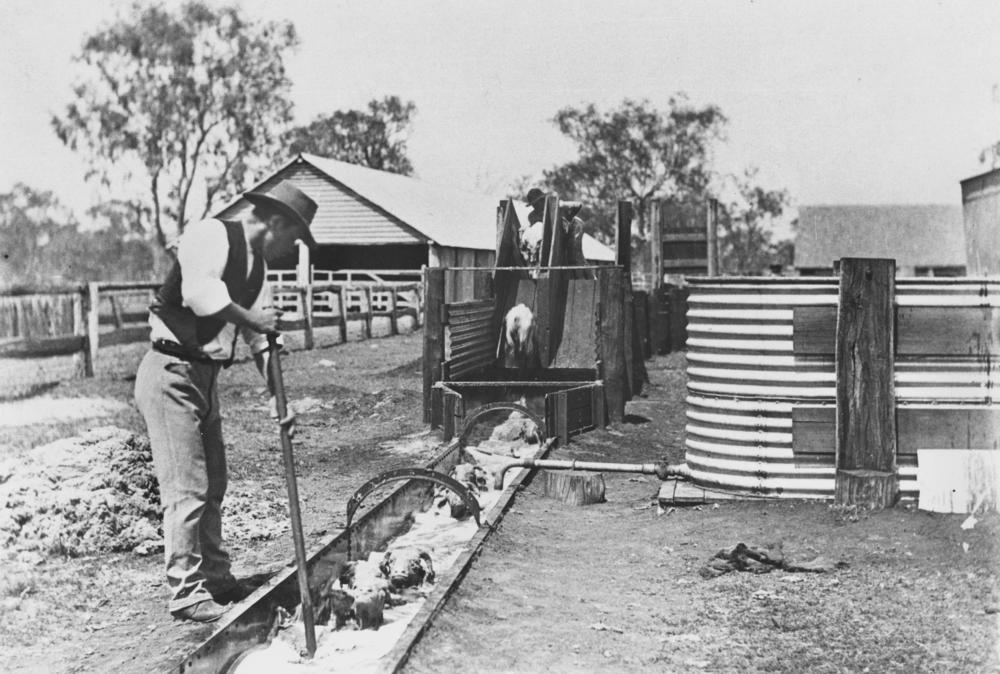

 Jon Bowie's Thoughts and Photos